Medically Reviewed by Dr. Sumit Agrawal | Published on May, 16 2026
FUE High-Density Grafting: Sagittal vs. Coronal Incisions
One of the most commonly asked questions by patients during consultation is how the incisions will be performed for graft placement during an FUE hair transplant. Well, many looking for hair transplant surgery are often apprehensive about the procedure, technology, and devices used; whether the procedure would be painful or not, and how it will be performed.
So if these questions keep coming up and make you anxious, you’re not alone. We’re here to simplify the whole treatment process for you from scratch!
What Are The Methods Of Incision in FUE Treatment?
Studies suggest that the natural orientation of collagen fibers must be considered when making incisions in the scalp. There’s an angle in which incisions are made across the scalp to implant grafts strategically into the recipient area using blades.
Moreover, to achieve natural results, the angle and direction in which grafted hair is placed should correspond with residual hair on scalp. So, this is the fundamental aspect of incision-making, that builds a strong foundation for the entire FUE process.
Two common methods used for recipient site creation are:
- Sagittal Incisions
- Coronal Incisions
The creation of recipient sites—tiny channels or incisions where grafts are implanted- plays a critical role in hair transplant surgery. The Incisions are approx 4mm beneath the skin in the subdermal plane.
So, if you’re planning to go for a hair transplant surgery in Clinics like Harleys, let’s find out about these two methods of creating recipient sites, how they work, the benefits, and more.
What is Sagittal Incision?
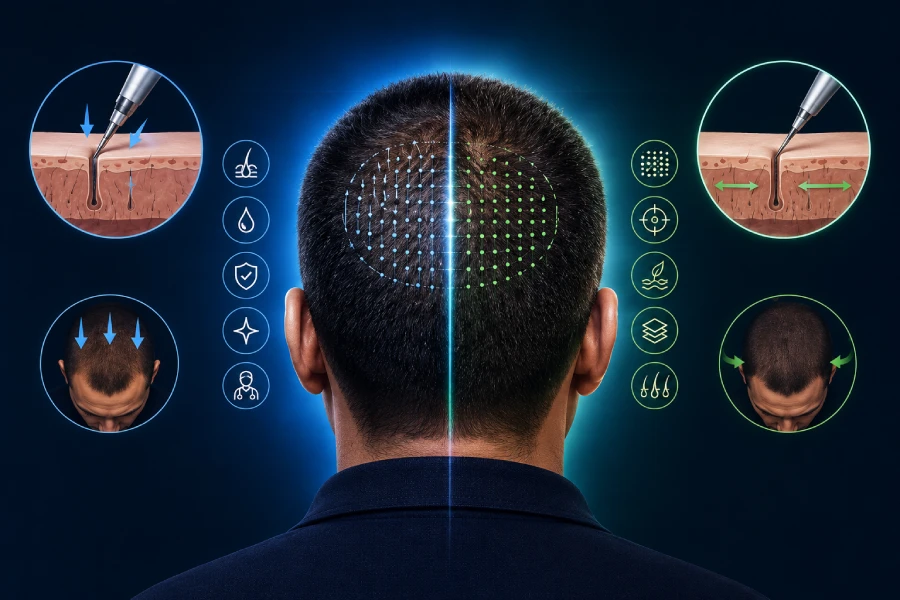
In the sagittal incision method, an incision is always made in the direction of hair growth, collagen fibres and across the scalp. It has a natural direction that follows the hair’s own plane. A surgeon uses a blade to create vertical incisions that align with the hair shaft axis. The placement of hair grafts with the help of sagittal incisions is done exactly how hair would naturally develop and grow.
Benefits of Sagittal Incisions
- Good control of hair direction
- high density packing between existing hair
- Parallel to Langers line so less bleeding
- Less scarring in tissues
- Helpful for creating natural frontal flow
- Familiar technique for many surgeons
What is Coronal Incision?
Coronal word implies vertical separation between the front and back sections of the body. Hence, coronal incisions are made side-to-side, perpendicular to the sagittal direction. In this method, the blade enters across the scalp rather than front-to-back.
Unlike a sagittal incision, the incisions of the coronal method are perpendicular to the direction of hair growth. Coronal incisions are created at acute angles, which run side by side with the hair growth pattern, aligning with scalp’s natural vascular structure. In a nutshell, the slit is horizontal (side-to-side) relative to the hair's path. It is also known as lateral slit technology because of its horizontal technique.
Benefits of Coronal Incisions
- Efficient spacing for high-density grafting
- Can allow closer graft packing
- Better angulation control for hair direction
- Useful for creating a layered fullness appearance
Devices Used By Surgeons in Incision Making
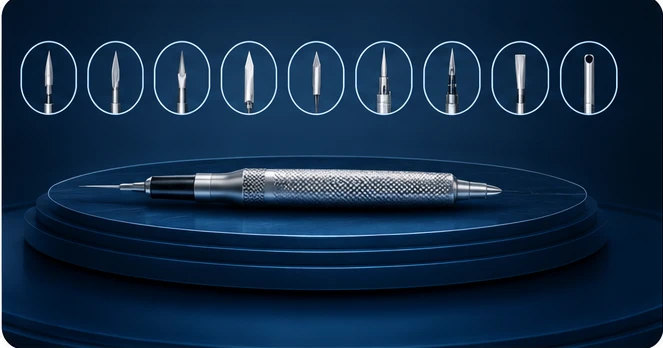
- Sapphire Blade
- Steel Slit Blade
- Custom Cut Blade
- Lateral Slit Blade
- Coronal Blade
- Needle Tip Blade
- Hypodermic Needle
- Micro Blade Knife
- Recipient Site Handle
- Slit Maker Tool
Key Considerations in Incision Making
A hair transplant surgeon ensures these factors that determine the quality of hair transplant:
- Natural hair direction and flow
- Correct angle of incision placement (coronal/sagittal)
- Proper depth according to graft size
- Adequate spacing for desired density
- Preservation of blood supply
- Protection of existing native hair
- Appropriate blade or needle size selection
- Symmetry and balanced design
- Natural hairline planning
- Minimal tissue trauma
- Secure graft fitting in recipient sites
- Faster healing and reduced scarring risk
- Customization as per scalp and hair type
- Surgeon's precision and experience
Sagittal vs Coronal Incisions: Key Differences
| Characteristics |
Sagittal Incisions (Parallel) |
Coronal Incisions (Lateral) |
| Blade Orientation |
Front-to-back |
Side-to-side |
| Density Packing |
Good |
Often preferred for High density |
| Hair Direction Control |
Excellent in skilled hands |
Excellent for frontal flow |
| Hairline Use |
Used selectively |
Common |
| Learning Curve |
More technique-sensitive |
Standard |
| Crown/Whorl Design |
Variable |
Depends on surgeon |
How Coronal Incisions Are Better for FUE High-Density Grafting? Know Here
- The coronal orientation facilitates graft placement more densely because there’s a narrow channel created that can carry the graft without stress and compression.
- Allows multi-hair follicular units (2–3 hair grafts) to be placed with good cosmetic integration
- Graft vascularity is better because of the narrow space during insertion, boosting survival rates in high-density sessions
The Hybrid Model: Why Top Surgeons Choose a Combination Approach?
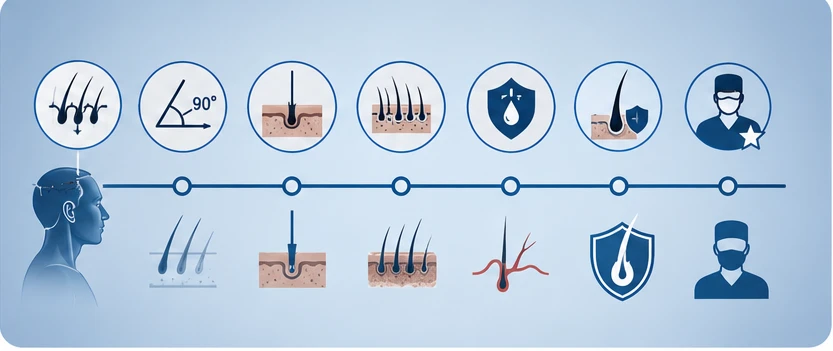
An experienced surgeon decides incision type, placement, pattern, and device based on individual scalp assessment, and considering suitable factors as per diagnosis.
There’s no one protocol, but how strategically a surgeon deals with the FUE graft technique.
A combination approach is mostly opted for by top hair transplant surgeons
- Coronal incisions for the very front of the hairline and temples to ensure the hair stays flat and directed correctly.
- Sagittal incisions for the mid-scalp and crown to create the illusion of thickness and "fullness."
The choice often depends on your specific hair type (straight vs. curly) and the degree of baldness being treated.
Conclusion
The FUE hair transplant surgery is largely influenced by the surgeon's blade choice (width, bevel, angle), the patient's native hair characteristics, and the target density, making recipient site creation a matter of precision, surgical finesse, and extensive experience during the entire FUE procedure.
Ready for a fuller, natural-looking hairline? Stay tuned with us for more such insightful reads.
FAQS
1. Can I touch my hair grafts after 7 days?
Avoid rubbing, scratching, touching surgically treated hair area for 14 days.
2. How long does hair transplant results last?
The Hair Transplant results are long lasting, as the transplanted hairs are from the Permanent zone of scalp
3. Which incision is better for a dense hair transplant?
Most surgeons prefer mixing coronal & Sagittal incisions for dense packing. Coronal Incisions for frontal hairline & Sagittal incisions for Midscalp.
4. Which technique gives more natural results?
Advanced Sapphire FUE, uses a combination of multiphasic motor FUE harvesting, slit making by Sapphire blades & Implanting by No root touch technique ‘KEEP’ Implanter.
5. Are these incisions painful?
No, local anesthesia is used during the entire procedure.
6. Do the slits leave scars?
They are tiny and usually heal inconspicuously.
7. What is the qualification of Dr. Sumit Agrawal?
Dr. Sumit Agrawal is double board certified Plastic Surgeon (India & UAE). He has been practicing hair Transplant and hair restoration since 2009. He is a highly experienced and best hair transplant surgeon in Mumbai.
8. Who performs the procedure at the clinic?
All the procedures in clinic are performed by Dr. Sumit Agrawal and his team with 10+years experience.
9. Where is Harleys Clinic located?
Jyoti Tower, 101-102, opp. Versova Police station, off Andheri Link Road, D.N.Nagar, Andheri West, Mumbai, Maharashtra 400053
 +91 9967333879