Medically Reviewed by Dr. Sumit Agrawal | Published on May, 12 2026
FUE Graft ‘Out-of-Body Time’ and Its Relevance
Did you know that for a hair transplant to be successful, the survival of every single hair graft is critical? However, during FUE (Follicular Unit Extraction), one of the key factor that decides the quality of hair regeneration apart from the technique, is its ‘Out-of-Body-Time.’
Read on to learn more about FUE graft out-of-body time and its relevance.
What is Out-of-Body Time (OBT) of a Graft?
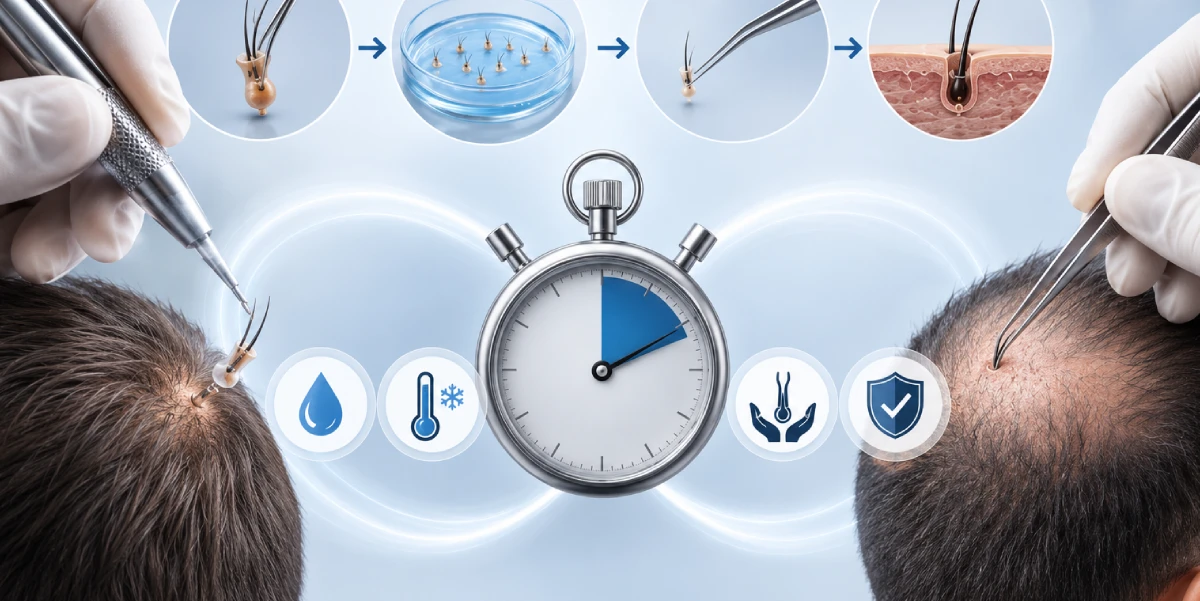
Out-of-Body Time is the total amount of time a graft remains outside the scalp, from the moment of extraction to implantation. The moment the graft is out of the scalp, it lacks blood supply, oxygen, and nutrients. Additionally, a higher duration of a graft remaining outside decreases the survival rate of grafts, thus impacting the hair regeneration.
Understanding the Role of Graft Time in FUE
The results and quality of hair transplant also rely on how long hair grafts remain outside the body and the kind of environment they’re present in. In a nutshell, the risk of cellular damage is higher if grafts are exposed to the harsh environment for a longer duration.
The out-of-the-body time is linearly proportional to the quality and frequency of hair regrowth after implantation. If weak or damaged grafts are implanted, the quality of hair growth is also undoubtedly impacted—the hair can either grow partially or wither away.
Minimizing out-of-body time ensures:
- Higher graft survival rate
- Better hair growth results
- Improved density and natural appearance
- Reduced chances of graft failure
How long can Grafts Survive during O-B-T Time?
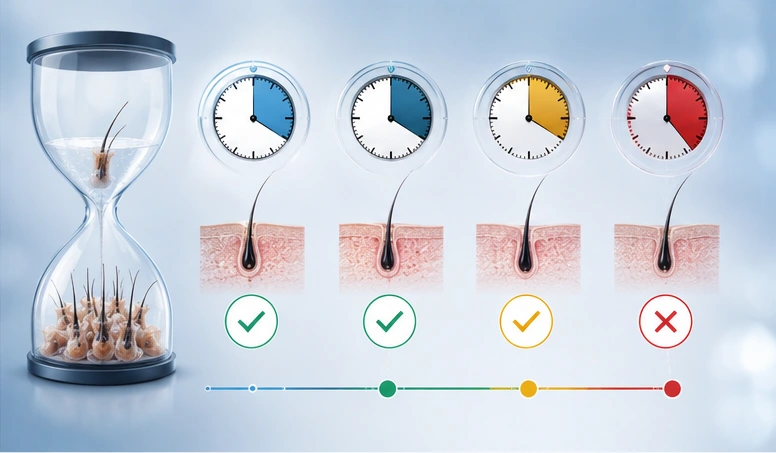
0–2 hours: Highest survival rate (99%+)
2–4 hours: High Survival if graft stored properly
4–6 hours: Graft survival starts to decline (~95%)
Beyond 6 hours: Noticeable reduction in graft viability
Why Are Hair Grafts Unable to Survive?
Once extracted, the follicle:
- Loses blood supply
- Lacks oxygen and nutrients
- Starts slowing down metabolically
- Becomes vulnerable to dehydration and cell death
Key Factors that Determine Graft Survival Outside The Body
There are several key factors that determine the rate of graft survival. Most of them are:
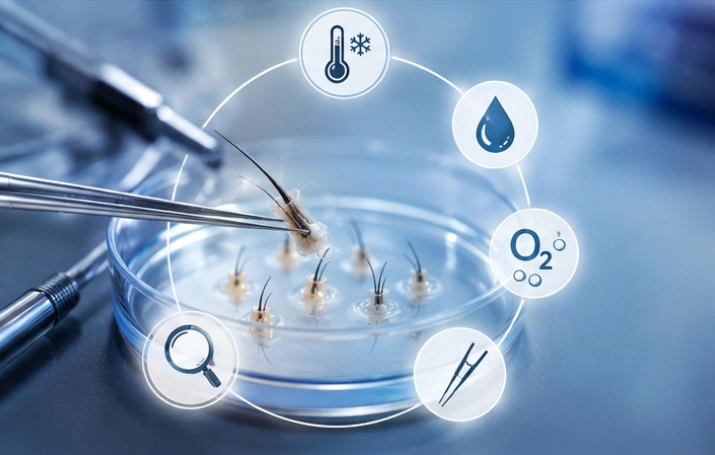
| Factor |
Primary Impact |
Why it Matters |
| Hydration |
Prevents Drying of hair |
Follicles are highly sensitive to air; drying can kill their cells |
| Temperature |
Metabolic Rate |
Chilling grafts to 4°C–8°C induces "hibernation," reducing the demand for oxygen and nutrients |
| Out-of-Body Time |
Ischemic Stress |
When a graft is away from the blood supply for a longer duration, it dies. |
| Holding Solution |
Chemical Environment |
Specialized solutions (like HypoThermosol) provide pH balance and nutrients that basic saline lacks. |
| Physical Handling |
Mechanical Trauma |
Grafts are fragile, and if team mishandles them, they get weak, and fail to trigger growth when implanted |
| Oxygenation |
Cellular Respiration |
Minimal oxygen exposure in the solution helps prevent the buildup of toxic metabolic byproducts. |
Hair Transplant Success: Know How O-B-T Is Crucial
1. OBT Duration
The primary role of OBT is its direct impact on graft survival,
- A long OBT: It increases the risk of graft dehydration and cell death (>4hrs)
- Short OBT: Higher survival rates (often 95–99% or more)
2. Hair Growth Quality
OBT doesn’t just affect whether grafts survive—it also impacts how well they grow.
- Shorter OBT– stronger, thicker, healthier hair
- Longer OBT– weaker growth, thinner strands, or delayed growth
3. Density and Coverage
High graft survival directly translates into better density.
- Efficient OBT management ensures uniform coverage
- Reduces chances of patchy or uneven results
4. Natural-Looking Outcomes
For a natural look, maximum graft needs to survive and grow in harmony.
- Proper OBT –Consistent growth pattern
- Minimal graft loss—Seamless blending with existing hair
Delayed implantation can disrupt this balance, affecting the final aesthetic outcome.
5. Graft handling
OBT is one of the important biological factor in graft handling , when out of body.
Clinics that prioritise:
- Batch-wise extraction and implantation
- Immediate graft placement
- Advanced preservation techniques
FAQs
Is hair transplant 100 % successful?
Yes, a hair transplant has higher success if O-B-T time is reduced and grafts are carefully handled and implanted by the Team. The more O-B-T time is reduced, the better is the quality of hair growth.
2. What is the ideal out-of-body time for grafts?
Ideally, grafts should be implanted within 30 minutes to 2 hours for maximum survival. However, with proper preservation, they maximum viability is for four hours.
3. What happens if grafts stay outside too long?
Prolonged OBT can lead to dehydration, reduced viability, and cellular damage to the grafts.
4. Can grafts survive longer if stored properly?
Yes, when stored in chilled solutions and proper preservation media, grafts can survive longer, but OBT time should be reduced.
6. Does OBT affect hair density after transplant?
Yes, shorter OBT leads to higher graft survival, which directly improves hair density and ensures fuller, more natural-looking results.
7. How do clinics reduce out-of-body time?
Clinics minimise OBT by using efficient techniques such as batch-wise implantation, smaller sessions of extraction and implantation, larger team and splitting Mega session over 2 days
8. How to improve graft handling
Graft handling can be improved by atraumatic Graft harvesting by multi-phasic Trivellini motor, handling of grafts by micro-instruments, all the steps under magnification by team, cold storage solution, Slits of correct dimension and depth by sapphire blade, and No root touch technique grafting by KEEP Implanter pens #advancedsapphirefue
9. Who performs the procedure at the clinic?
All the procedures in clinic are performed by Dr. Sumit Agrawal and his team with 10+years experience.
 +91 9967333879