Medically Reviewed by Dr. Sumit Agrawal | Published on Jul, 01 2026
FUE vs FUT Hair Transplant: Which Technique is Right for You?
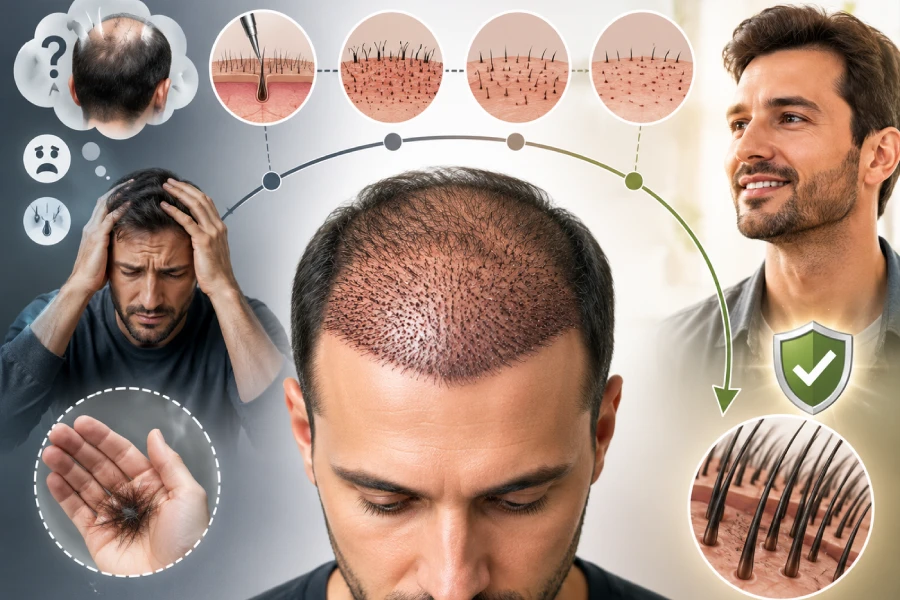
Hair loss can affect not just your appearance but also your confidence and self-image. Fortunately, advances in hair restoration have made it possible to achieve natural-looking and long-lasting results through modern hair transplant procedures. However, one question almost every patient asks during a consultation is: Should I choose FUE or FUT hair transplant?
At Harleys Hair Transplant Clinic, this is one of the most common discussions patients have with Dr. Sumit Agrawal, an experienced and highly-coveted hair transplant surgeon in Mumbai, who has helped thousands of individuals address hair loss concerns. While both procedures are proven and effective, the right choice depends on factors such as your hair loss pattern, donor hair availability, lifestyle, goals, and future hair restoration needs.
The reality is that there is no universally "better" technique. Both FUE (Follicular Unit Extraction) and FUT (Follicular Unit Transplantation) have their own advantages and limitations. Understanding the differences can help you make a more informed decision and have a more productive discussion with your surgeon.
Let's explore the key differences between these two popular hair transplant techniques.
Understanding FUE and FUT Hair Transplant
Before comparing both the procedures, it's important to understand what each procedure involves.
What is FUE Hair Transplant?
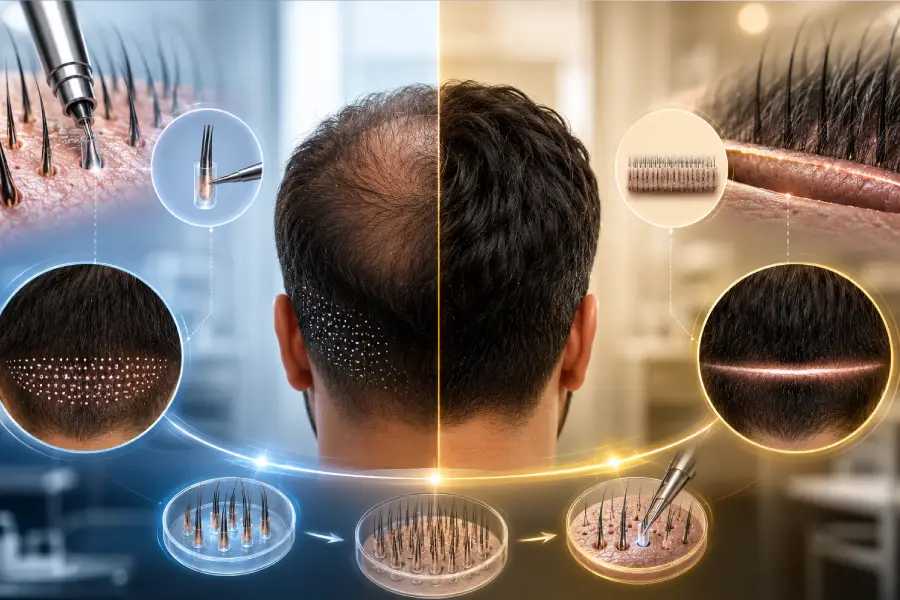
Follicular Unit Extraction (FUE) involves extracting individual hair follicles directly from the donor area, usually the back and sides of the scalp. These follicles are then implanted into areas experiencing thinning or baldness.
Since follicles are removed individually, FUE does not require a linear incision and leaves tiny dot-like scars that are often difficult to notice.
What is FUT Hair Transplant?
Follicular Unit Transplantation (FUT), often called the strip method, involves removing a thin strip of scalp from the donor area. The strip is then carefully dissected into individual follicular units, which are implanted into the recipient area.
FUT leaves a linear scar in the donor area, which is usually concealed beneath longer hair.
Both procedures aim to achieve the same outcome: restoring hair growth using your own natural hair follicles.
FUE vs FUT: Procedure Comparison
FUE Procedure
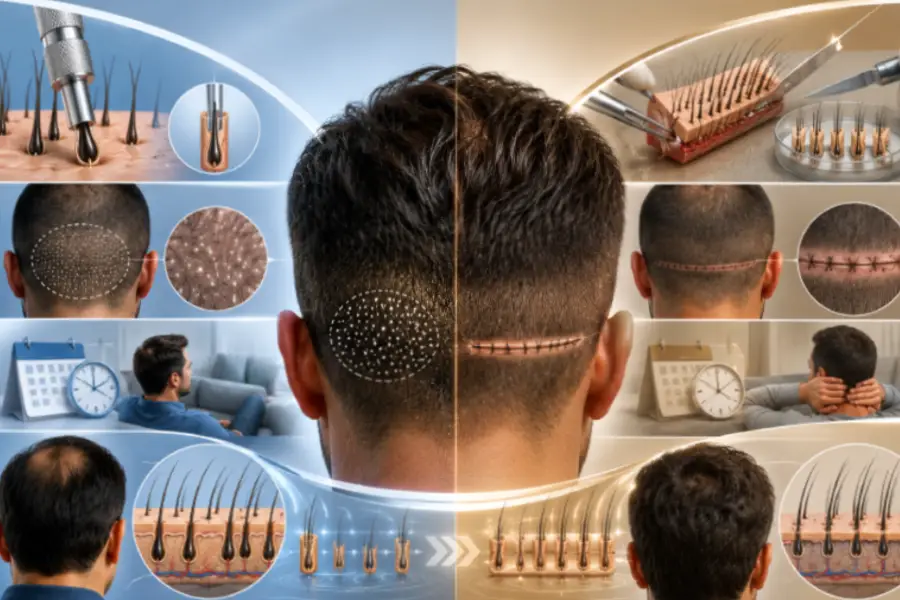
In FUE, individual follicular units are harvested one by one using specialized extraction tools. The process is meticulous and can take several hours depending on the number of grafts required.
Patients often appreciate FUE because it is minimally invasive and does not involve stitches.
FUT Procedure
In FUT, a strip of scalp is surgically removed from the donor area and the wound is closed with sutures. Hair follicles are then separated under magnification and prepared for transplantation.
While the harvesting process is different, the implantation stage remains similar to FUE.
FUE vs FUT: Scarring Comparison
Scarring is one of the biggest deciding factors for many patients.
FUE Scarring
FUE creates tiny circular scars spread throughout the donor area. These scars are usually difficult to detect, especially when hair is kept short.
This makes FUE a popular choice among individuals who prefer shorter hairstyles.
FUT Scarring
FUT leaves a single linear scar across the donor area where the strip was removed.
Although the scar can often be hidden under longer hair, it may become visible if the hair is cut very short.
FUE vs FUT: Recovery and Downtime
Recovery After FUE
Most patients experience relatively mild discomfort and a faster recovery period after FUE.
Since there are no stitches involved, patients often return to routine activities sooner.
Recovery After FUT
FUT typically requires a slightly longer healing period because of the surgical incision and stitches.
Some patients may experience tightness or discomfort in the donor area during recovery.
FUE vs FUT: Graft Yield and Coverage
One of the major advantages of FUT is the ability to obtain a large number of grafts in a single session.
FUE Graft Yield
FUE can provide excellent results but may require longer sessions when a large number of grafts are needed.
FUT Graft Yield
FUT often allows surgeons to harvest a higher number of grafts efficiently, making it beneficial for patients with extensive hair loss.
For individuals requiring significant coverage, FUT may sometimes be recommended as part of a comprehensive restoration strategy.
FUE vs FUT: Natural Appearance of Results
A common misconception is that one technique provides more natural-looking results than the other.
The truth is that naturalness depends far more on the surgeon's skill than the harvesting method.
When performed correctly, both FUE and FUT can produce:
- Natural hairlines
- Appropriate density
- Seamless blending with existing hair
- Long-lasting hair transplant results
The artistry and experience of the surgeon play a far greater role than the technique itself.
FUE vs FUT: Suitability for Different Candidates
Ideal Candidates for FUE
FUE may be suitable for:
- All cases of hair loss upto Norwood Grade 6
- Patients who prefer shorter hairstyles
- Individuals concerned about linear scarring
- Those seeking a minimally invasive approach
- Patients with mild to moderate hair loss
Ideal Candidates for FUT
FUT may be suitable for:
- Individuals with extensive baldness
- Patients requiring a large number of grafts
- Those who typically keep longer hair
- Patients with strong donor area density
A detailed assessment is necessary to determine which option aligns with your specific needs.
FUE vs FUT: Cost Comparison
Cost is another factor that influences decision-making.
In many cases, FUE procedures may cost more because of the time-intensive nature of extracting individual follicles.
FUT can sometimes be more cost-effective when a larger number of grafts are required.
However, pricing varies based on:
- Number of grafts
- Degree of hair loss
- Clinic expertise
- Surgeon's experience
- Treatment complexity
Rather than focusing solely on cost, patients should consider long-term value, safety, and expected outcomes.
FUE vs FUT: Side-by-Side Comparison
| Factor |
FUE Hair Transplant |
FUT Hair Transplant |
| Harvesting Method |
Individual follicle extraction |
Strip of scalp removed |
| Scarring |
Tiny dot-like scars |
Linear scar |
| Recovery Time |
Generally faster |
Slightly longer |
| Stitches Required |
No |
Yes |
| Suitable for Short Haircuts |
Yes |
Less suitable |
| Graft Yield |
Moderate to high |
Often higher in one session |
| Procedure Duration |
Usually longer |
Often shorter for large graft sessions |
| Post-Procedure Discomfort |
Typically mild |
Slightly higher initially |
| Cost |
Often higher |
Can be more economical for large sessions |
| Final Results |
Natural when performed well |
Natural when performed well |
Which Hair Transplant Technique Is Right for You?
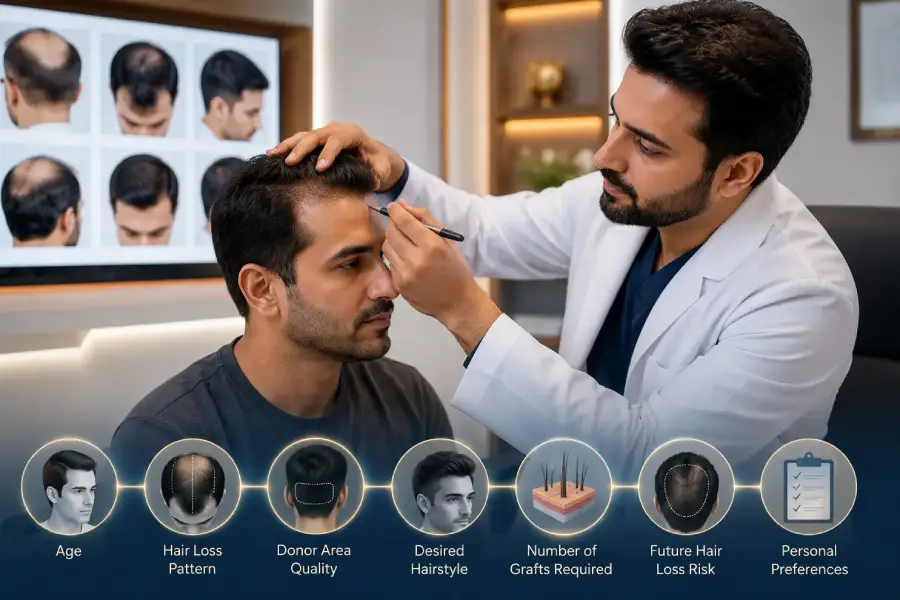
The most important thing to understand is that there is no one-size-fits-all answer, when it comes to hair transplant technique.
The right choice depends on multiple factors, including:
- Your age
- Hair loss pattern
- Donor area quality
- Desired hairstyle
- Number of grafts required
- Future hair loss risk
- Personal preferences
This is why self-diagnosing based on internet research can be misleading.
An experienced hair transplant surgeon evaluates your scalp, donor reserves, long-term hair loss progression, and aesthetic goals before recommending a treatment plan.
At Harleys Hair Transplant Clinic, Dr. Sumit Agrawal carefully assesses each patient's individual needs before suggesting whether FUE or FUT would provide the most effective and sustainable outcome. The recommendation is always based on what will deliver the best long-term results rather than simply choosing the latest or most popular technique.
Your Next Step Towards Hair Restoration
Both FUE and FUT are proven hair restoration techniques that have helped millions of people regain fuller, natural-looking hair. While FUE offers minimal scarring and faster recovery, FUT can be highly effective for patients requiring larger graft numbers and extensive coverage.
The best technique is ultimately the one that aligns with your unique hair loss pattern, donor area characteristics, and long-term goals.
If you're considering a hair transplant and are unsure which procedure is right for you, a professional consultation can provide clarity. At Harleys Hair Transplant Clinic, Dr. Sumit Agrawal takes a personalized approach to treatment planning, helping patients understand their options and choose the technique most likely to deliver natural, long-lasting, and aesthetically pleasing results.
FAQs
Which is better – FUE or FUT?
Neither FUE nor FUT is universally better; the ideal choice depends on factors such as your hair loss pattern, donor hair availability, lifestyle, and restoration goals. Both techniques can deliver excellent, natural-looking results when performed by an experienced hair transplant surgeon. More than 80% of hair Transplants were FUE as per latest ISHRS Census 2025.
Which is more painful – FUT or FUE?
Both procedures are performed under local anaesthesia, so patients typically experience minimal discomfort during the treatment. However, FUT may involve slightly more post-procedure discomfort due to the donor area incision and stitches, while FUE generally offers a more comfortable recovery.
Which hair transplant is more expensive – FUT or FUE?
In many cases, FUE tends to be more expensive than FUT because it involves the extraction of individual hair follicles, making the procedure more time-intensive. However, the overall cost depends on several factors, including the number of grafts required and the complexity of the case.
How will I know which hair transplant is best for me?
The best way to determine the right procedure is through a detailed consultation with a qualified hair transplant surgeon. Your age, extent of hair loss, donor area quality, future hair loss risk, and aesthetic goals all play a role in deciding whether FUE or FUT is the more suitable option.
Who is the best FUT hair transplant doctor in Mumbai?
The best FUT hair transplant doctor is one who combines surgical expertise, experience, and a strong track record of delivering natural-looking results. Dr. Sumit Agrawal a Plastic Surgeon of Harleys Hair Transplant Clinic is recognized by many patients for his personalized treatment planning and expertise in both FUT and FUE hair restoration procedures.
Who is the best FUE hair transplant doctor in Mumbai?
When choosing a FUE hair transplant surgeon, it is important to consider experience, patient outcomes, and the surgeon's involvement in the procedure. Dr. Sumit Agrawal at Harleys Hair Transplant Clinic is regarded as one of Mumbai's experienced hair transplant surgeons, known for creating natural hairlines and long-lasting hair transplant results through advanced FUE techniques.
 +91 9967333879