Medically Reviewed by Dr. Sumit Agrawal | Published on Jul, 13 2026
How Dr. Sumit Agrawal Performs Natural-Looking Hairlines?
When it comes to hair transplant surgery, patients today are far more aware and particular about results than ever before. They no longer want just “more hair” — they want a hairline that looks undetectable, natural, age-appropriate, and perfectly suited to their face. One of the biggest fears among patients is ending up with an artificial-looking hairline that appears too straight, too dense, or poorly angled.
This is where Dr. Sumit Agrawal focuses on combining medical precision with artistic understanding. Known for his expertise in advanced hair restoration procedures, Dr. Sumit Agrawal approaches every hairline design as a completely personalised process rather than following a one-size-fits-all template.
Using advanced FUE and FUT techniques, detailed facial assessment, and precision-based graft placement, he creates hairlines that blend naturally with the patient’s facial structure, age, hair texture, and long-term hair loss pattern. The goal is not simply to restore lost hair — but to recreate a hairline that feels authentic, balanced, and naturally yours.
In this blog, understand how Dr. Sumit Agrawal crafts natural-looking hairlines and why achieving realistic results requires both surgical expertise and artistic planning.
Why Natural Looking Hairline Design Matters?
A natural-looking hairline is a hairline design that aligns with the patient’s natural hair growth pattern, facial structure, age, and hair density.
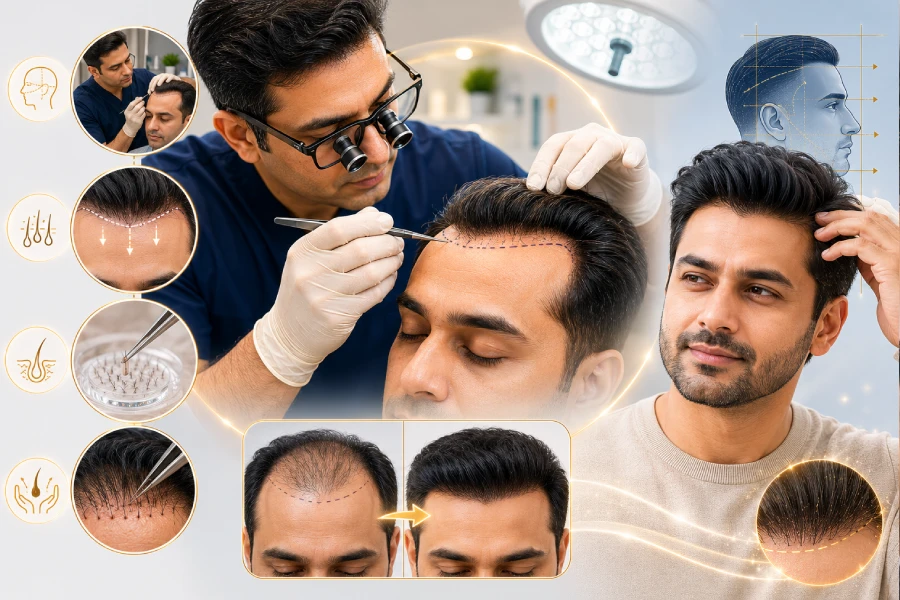
Key Features of a Natural-Looking Hairline
- Designed according to the patient’s face shape and forehead size
- Uses single hair grafts at the front
- Follows natural hair growth direction and angle
- Avoids overly straight or very low hairlines
- Maintains density and shape according to age
- Creates gradual transitions for realistic results
How do doctors design the hairline?
Here are simple steps in which doctors perform a natural hairline design:
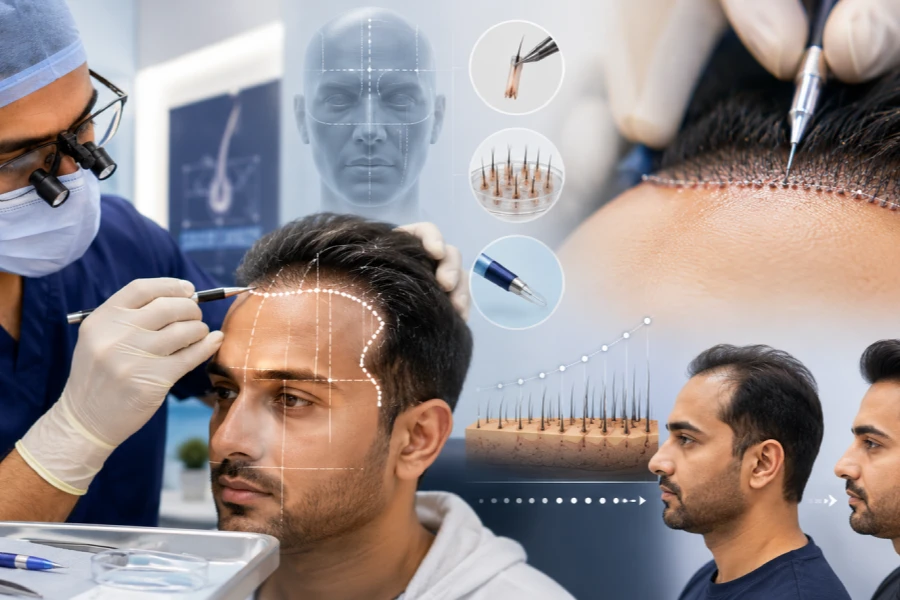
Step 01: Facial analysis & proportions
The doctor examines face shape, forehead height, facial thirds, and age-appropriate positioning before drawing a single mark.
Step 02: Hairline mapping & marking
Using a surgical marker, the surgeon draws the proposed hairline — often with deliberate macro & micro-irregularities to mimic nature.
Step 03: Graft selection & zoning
Single-follicle grafts go at the very edge; 2–3 hair grafts are placed further back to build density progressively.
Step 04: Angle & direction control
Each incision is made at a precise angle — typically 15–45° — matching native growth direction for a flat, natural lie.
Factors that determine natural-looking hairline designs?
Natural-looking results begin long before the surgery starts. During consultation, the surgeon studies:
- Face shape
- Forehead size
- Existing hair pattern
- Hair texture
- Donor hair quality
- Future hair loss possibility
- Age and lifestyle
Graft Placement Techniques For Natural Hairline Designs: FUE & FUT
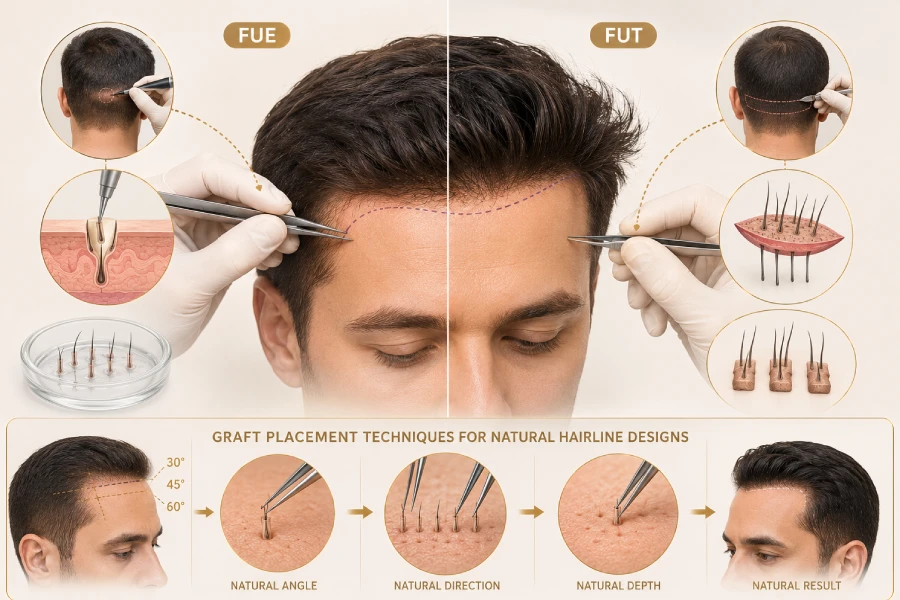
The graft placement technique is what truly matters during hair transplant surgery. Even a minor confusion in angle, direction, and depth of incision can create a faulty hairline design that looks unnatural.
Follicular unit transplantation (FUT) and follicular unit extraction (FUE) both allow doctors to work with individual follicular units, giving them fine-grained control over exactly which grafts go where.
What happens during a FUE Hair Transplant?
- Individual hair follicles are extracted from the donor area
- Specialized micro-punch tool is used for graft removal
- No major stitches are required
- Grafts are carefully implanted in bald areas
- Minimal scarring with faster recovery
- Suitable for patients preferring short hairstyles
What happens during a FUT Hair Transplant?
- A thin strip of scalp is removed from the donor area
- Hair grafts are separated under a microscope
- The donor area is closed with stitches
- Grafts are implanted into thinning areas
- Can provide a large number of grafts in one session
- Leaves a linear scar hidden under hair
Dr. Sumit Agrawal has expertise in both FUT and FUE hair transplant techniques and uses advanced tools like Sapphire blades and Trivellini systems for precision-based graft harvesting and implantation
Density Gradient
Natural hair does not grow at uniform density across the scalp. It’s never linear or straight.
The hairline zone, in particular, begins sparse and gradually increases in density moving backward. Surgeons replicate this density gradient intentionally — placing grafts at lower density at the very front and increasing concentration behind.
A skilled surgeon balances:
- Hair spacing
- Graft survival
- Blood supply
- Natural appearance
Wrapping up
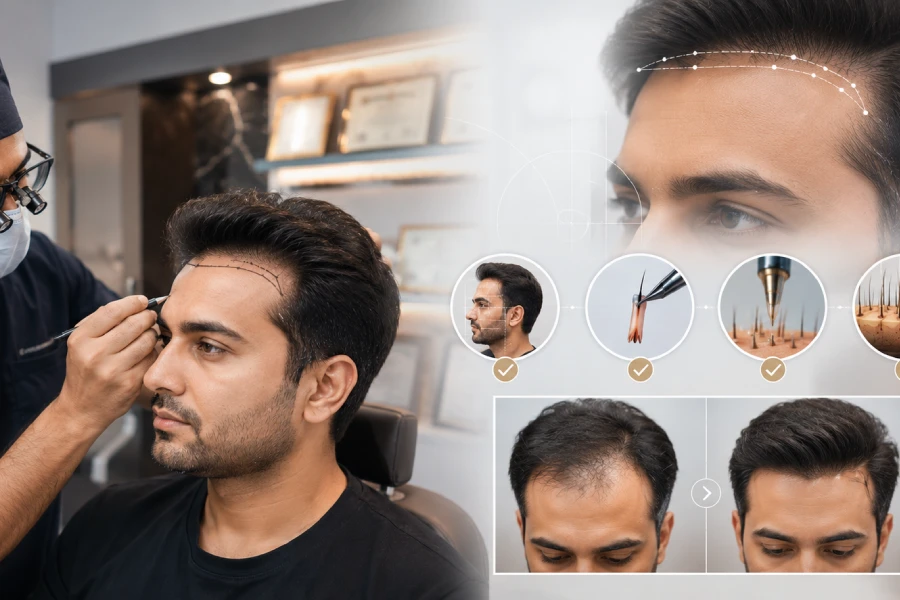
Creating a natural-looking hairline is one of the most important parts of successful hair transplant surgery. It requires detailed planning, artistic understanding, proper graft selection, and advanced implantation techniques. Creating harmony with the patient’s face plays an essential role in a doctor’s way of creating natural hairline designs.
At Harleys Hair Transplant Clinic, personalised hairline design, modern technology, and the expertise of Dr. Sumit Agrawal deliver results that look subtle, balanced, and natural.
Book a consultation with Dr. Sumit Agrawal today, and get the perfect solution to your hair loss.
FAQs
1. How do surgeons create a natural-looking hairline design?
Surgeons design the hairline based on facial structure, age, hair pattern, and natural hair growth direction to ensure realistic results. They use FUE or FUT technique based on their diagnosis and requirement.
2. Does a natural-looking hairline use single hair grafts?
Yes, single follicular grafts are usually placed at the front of the hairline to create a soft and natural appearance. The surgeon creates macro & micro irregularities for a perfect natural looking hairline.
3. Can I regrow a lost hairline?
Yes, a receding hairline can often grow back or be significantly improved. Regrowth depends on early intervention.
4. What vitamins help in hairline growth?
Vitamins D, B, C, and A play an important role in the hair growth cycle. These vitamins are effective in treating alopecia areata deficiency.
5. Why do hair transplant hairlines look fake?
A hairline that is too straight or set too low on the forehead can create an unnatural look. A procedure may look unnatural if the surgeon did not perform hair transplant properly.
 +91 9967333879