Medically Reviewed by Dr. Sumit Agrawal | Published on Jul, 02 2026
How Many Hair Grafts Do You Actually Need? A Surgeon's Formula
One of the first questions people ask when considering a hair transplant is: "How many grafts will I need?"
Unfortunately, there is no universal answer.
Two individuals with seemingly similar hair loss can require completely different graft counts based on factors such as scalp size, donor hair density, hair characteristics, future hair loss progression, and desired coverage. This is why experienced hair transplant surgeons avoid giving a graft estimate without a proper evaluation.
At Harleys Hair Transplant Clinic, one of the most common topics discussed during consultations with Dr. Sumit Agrawal is graft planning. As an experienced hair transplant surgeon, Dr. Agrawal believes that determining the right number of grafts is one of the most important aspects of achieving natural-looking and long-lasting hair transplant results. Too few grafts can result in inadequate coverage, while poor planning can unnecessarily exhaust valuable donor hair reserves.
In this blog, we'll explain how graft requirements are calculated, how the Norwood Scale influences treatment planning, and how many grafts are typically needed at different stages of hair loss.
What Is a Hair Graft? How Is It Used in Hair Transplantation?
A hair graft is a naturally occurring group of hair follicles extracted from the donor area and transplanted into areas affected by hair loss.
Each graft may contain:
- 1 hair follicle
- 2 hair follicles
- 3 hair follicles
- Occasionally 4 hair follicles
Many patients mistakenly assume that one graft equals one hair. In reality, a single graft often contains multiple hairs.
For example:
- 2,000 grafts may contain approximately 4,000 to 5,000 hairs
- 3,000 grafts may contain approximately 6,000 to 7,500 hairs
The total number of grafts required depends on the amount of coverage needed and the density you wish to achieve.
The Norwood Scale and Determining the Degree of Baldness
Before estimating graft requirements, surgeons first evaluate the extent of hair loss.
The most widely used classification system for male pattern baldness is the Norwood Hair Loss Scale, which categorizes hair loss into seven stages.
As the Norwood stage increases, the area requiring restoration becomes larger, which generally increases the number of grafts needed.
While graft calculations vary from patient to patient, the following ranges provide a useful guideline.
How Many Hair Grafts Are Needed at Different Stages of Baldness?
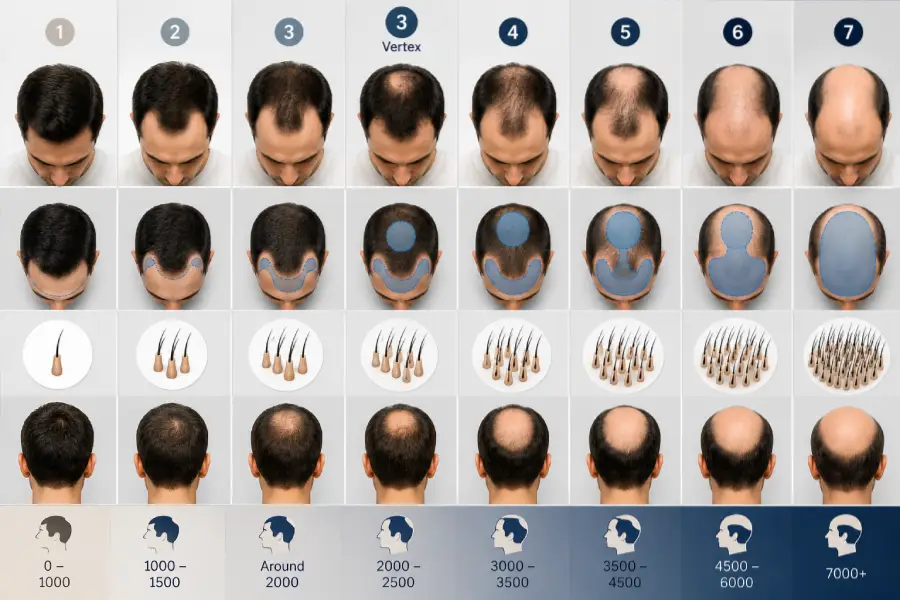
Stage 1 | 0–1000 Grafts
At this stage, there is little to no visible hair loss.
Patients may seek minor hairline refinement or correction of naturally high hairlines.
Typical graft requirement:
0–1000 grafts
Stage 2 | 1000–1500 Grafts
Stage 2 is characterized by mild recession around the temples.
The goal is usually hairline enhancement and restoration of temple corners.
Typical graft requirement:
1000–1500 grafts
Stage 3 | Around 2000 Grafts
Hairline recession becomes more noticeable, and baldness begins to develop.
Patients often require restoration of the frontal hairline and frontal third of the scalp.
Typical graft requirement:
Approximately 2000 grafts
Stage 3 Vertex | 2000–2500 Grafts
In addition to frontal recession, patients experience thinning at the crown (vertex).
This requires graft allocation between the frontal region and crown.
Typical graft requirement:
2000–2500 grafts
Stage 4 | 3000–3500 Grafts
The frontal and crown areas become more distinct zones of hair loss.
Coverage requirements increase significantly.
Typical graft requirement:
3000–3500 grafts
Stage 5 | 3500–4500 Grafts
The bridge of hair separating the frontal and crown areas becomes thinner.
A larger restoration area requires more strategic graft placement.
Typical graft requirement:
3500–4500 grafts
Stage 6 | 4500–6000 Grafts
Hair loss becomes extensive, with only limited hair remaining on the top of the scalp.
Achieving balanced density becomes the primary focus.
Typical graft requirement:
4500–6000 grafts
Stage 7 | 7000+ Grafts
This is the most advanced stage of hair loss.
Large bald areas often require multiple sessions and careful donor management.
Typical graft requirement:
7000+ grafts
Not every Stage 7 patient can receive 7000 grafts in a single procedure. Treatment plans are often customized based on donor availability and long-term goals.
How Do Hair Transplant Surgeons Calculate Hair Graft Requirements?
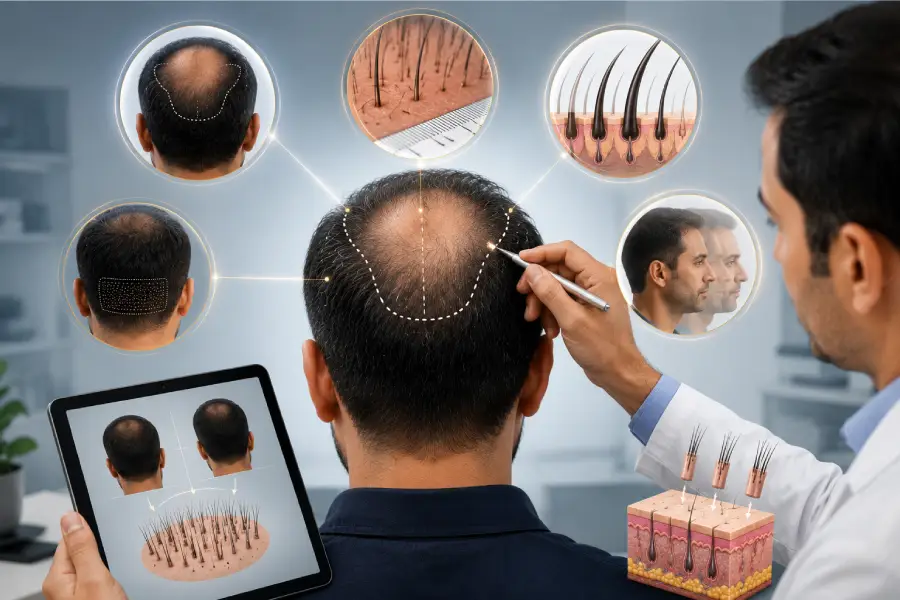
Contrary to popular belief, graft requirements are not determined solely by the Norwood stage.
Experienced surgeons evaluate multiple variables, including:
Size of the Bald Area
Larger treatment areas naturally require more grafts.
Desired Density
Higher density demands more grafts per square centimetre.
Hair Characteristics
Thicker hair provides greater visual coverage.
Donor Area Quality
A strong donor area allows for greater graft harvesting.
Future Hair Loss Progression
Long-term planning helps preserve donor reserves for future needs.
This is why graft calculations should always be individualized rather than based solely on online graft calculators.
How Many Hair Grafts Does the Average Person Have for a Hair Transplant?
Most people have approximately:
- 5,000–8,000 transplantable grafts available in the donor area
- Some individuals may have more
- Others may have fewer depending on genetics and hair density
However, not all donor grafts should be harvested.
Experienced surgeons aim to preserve donor area aesthetics while maintaining sufficient reserves for future procedures if needed.
How Are Extracted Grafts Allocated During a Hair Transplant?
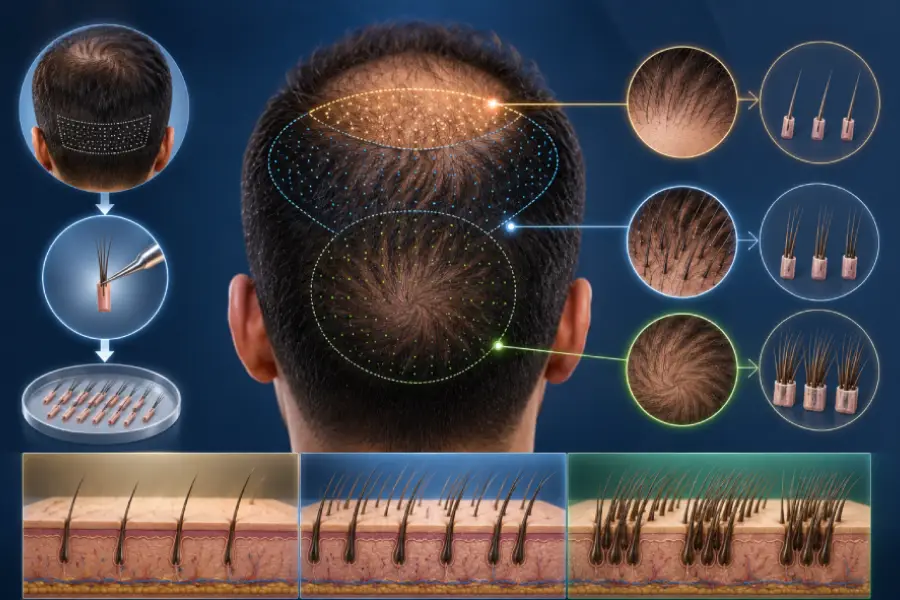
Graft placement is just as important as graft quantity.
Typically, surgeons allocate grafts strategically across different zones.
Hairline Zone
Single-hair grafts are commonly used to create a soft and natural hairline.
Mid-Scalp Zone
Higher-density graft placement helps create fullness.
Crown Zone
The crown often requires careful planning due to its circular growth pattern and larger surface area.
Proper graft allocation plays a major role in achieving natural-looking hair transplant results.
How Many Grafts Per cm² Are Needed for Natural Density?
Natural hair density varies among individuals, but surgeons generally work within specific density ranges.
Typical transplant densities include:
| Coverage Goal |
Approximate Grafts per cm² |
| Light Coverage |
25–30 grafts/cm² |
| Moderate Density |
35–40 grafts/cm² |
| High Density |
45–50 grafts/cm² |
| Dense Packing (Selected Cases) |
50–60 grafts/cm² |
Achieving the right balance is more important than pursuing the highest possible density. Strategic placement often creates better visual fullness than simply increasing graft numbers.
Estimated Grafts Needed by Area
- Hairline & Temples: 1,000 - 2,500 grafts. Surgeons use single-hair grafts to create a soft, natural edge.
- Crown (Vertex): 1,000 - 3,000 grafts. Because of the circular growth pattern, the crown usually requires a higher density.
- Full Scalp Restoration: 2,500 - 4,000+ grafts. This is typically divided into multiple sessions to preserve the donor area.
Which Factors Affect the Number of Grafts Required?
Several factors influence how many grafts a patient needs:
Hair Colour
Lower contrast between hair and scalp often requires fewer grafts.
Hair Thickness
Thicker hair creates greater visual density.
Hair Curl
Curly and wavy hair provides more scalp coverage.
Scalp Laxity
This can affect donor harvesting options.
Gender
Female pattern hair loss often requires a different graft planning approach.
Long-Term Hair Loss Risk
Future progression influences current treatment planning.
What If the Donor Area Is Insufficient?
Not every patient has unlimited donor hair.
When donor reserves are limited, surgeons may recommend:
- Prioritizing the frontal hairline
- Staged restoration plans
- Beard hair transplantation in selected cases
- Combination treatment approaches
- Medical therapies to preserve existing hair
The goal is to maximize cosmetic improvement while preserving donor resources for the future.
Why Accurate Graft Planning Matters More Than Chasing Numbers?
Many patients focus on achieving the highest possible graft count, but successful hair restoration is not simply about transplanting more hair.
The real objective is creating a natural-looking result that complements your facial structure, age, donor availability, and long-term hair loss pattern.
This is why experienced surgeons focus on personalized graft planning rather than offering fixed graft packages. A carefully designed treatment plan often produces better outcomes than simply maximizing graft numbers.
If you're considering a hair transplant and want an accurate assessment of how many grafts you actually need, a professional consultation can provide clarity. At Harleys Hair Transplant Clinic, Dr. Sumit Agrawal evaluates each patient's hair loss stage, donor capacity, scalp characteristics, and future hair restoration needs before recommending a treatment strategy. As one of the best hair transplant surgeons in Mumbai, he believes that successful hair restoration begins with realistic planning, thoughtful graft allocation, and a long-term approach tailored to each individual.
FAQs
How much coverage will 3,000 grafts cover?
Around 3,000 grafts can typically restore the hairline and mid-scalp, with some coverage of the crown depending on the extent of hair loss and desired density.
Is 5,000 hair grafts a lot?
Yes, 5,000 grafts is considered a large hair transplant and is often used for patients with advanced hair loss.
How long do hair grafts last?
Transplanted hair grafts are generally permanent and can continue growing for decades when they successfully establish themselves.
Is 1 graft equal to 1 hair?
No. A single graft usually contains 1 to 4 hairs, with an average of 2 to 3 hairs per graft.
How can I determine the quality of my hair grafts?
An experienced hair transplant surgeon can assess your donor area and evaluate the strength, density, and overall quality of your grafts.
 +91 9967333879